What Is Variegation
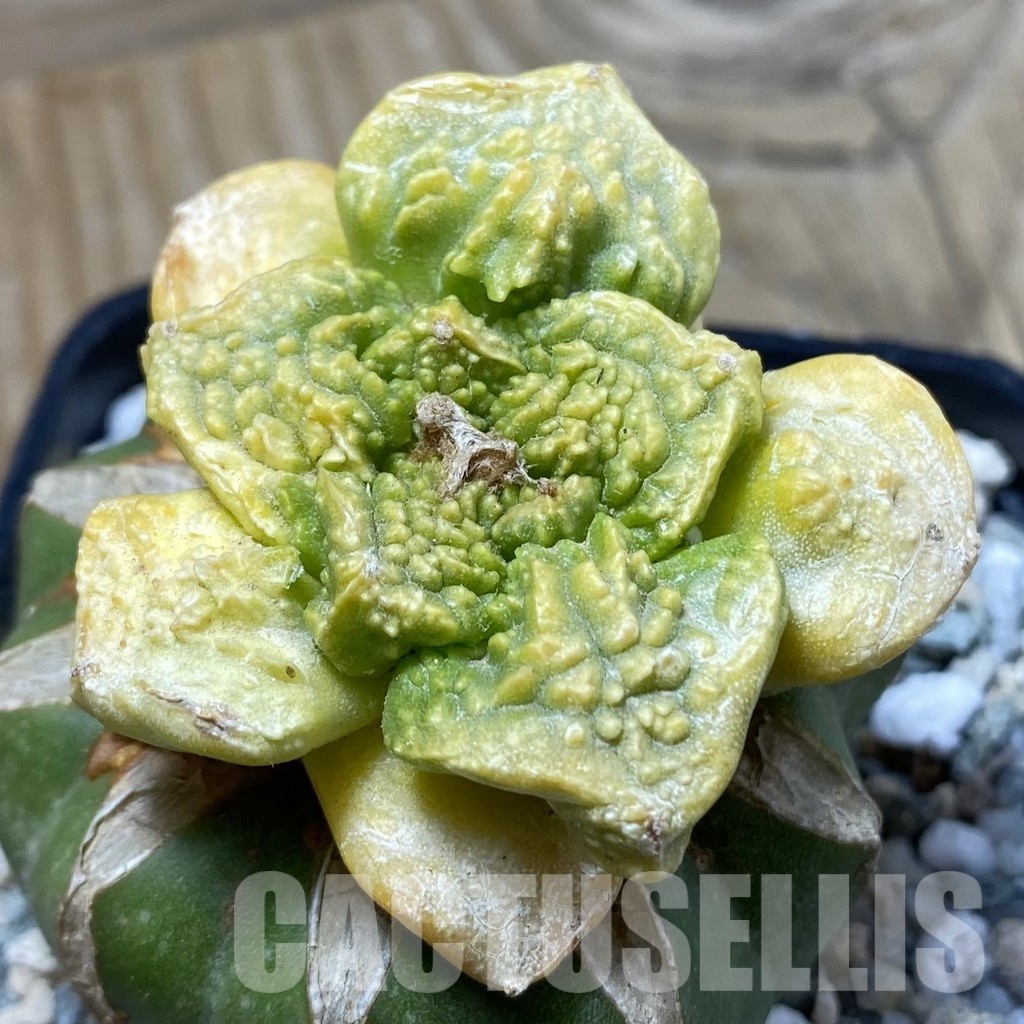
Variegation is the stable appearance of light (cream, white, yellow, or pink) areas on the leaves or stems of plants, caused by a lack or reduction of chlorophyll in part of the tissues.
This effect may result from two main mechanisms:
1️⃣ Meristem chimerism – different genetic layers coexist within the same plant: normal (green) and chlorophyll-deficient (light).
The most stable form is the periclinal chimera, where these layers are arranged evenly and consistently.
2️⃣ Mutations in the plastid genome – changes in chloroplast DNA cause mosaic coloration patterns and are often passed down maternally rather than genetically in the usual way.
Why Succulents Often Develop Variegation
Succulents frequently produce variegated forms due to three main reasons:
🌱 Somatic mutations – during frequent vegetative propagation (leaf cuttings, offsets, or stem cuttings), random cell mutations can occur.
When such a mutation affects meristematic tissue, it can become fixed, resulting in a new variegated line.
🪴 Chimeric stability – certain types of chimeras remain stable when propagated from apical or side shoots, especially in Echeveria, Haworthia, Crassula, and similar genera.
🌵 Grafting – a common practice for variegated cacti.
Since variegated plants grow more slowly, they are grafted onto strong, fast-growing rootstocks (for example, Myrtillocactus geometrizans), which helps preserve and multiply the variegated tissue.
Variegation Through Leaf Propagation and Seeds
In Echeveria, Haworthia, and other succulents, repeated leaf propagation often leads to new variegation patterns.
Each new leaf cutting is a potential new line — sometimes with stronger variegation, sometimes with a complete loss of it.
Over time, some of these stabilized lines begin to produce variegated seedlings.
This happens when the mutation is located in the plastid genome and is inherited maternally.
Why Plants Sometimes “Revert” to Green
This process is called reversion.
It occurs when the green tissue gains a growth advantage — because it contains more chlorophyll and produces more energy.
Therefore, it is important to regularly remove purely green shoots; otherwise, they will overtake and replace the variegated sections.
Variegation in Tissue Culture
In micropropagation in vitro, random variegated mutations (known as somaclonal variations) may appear.
However, such variegation is often unstable and requires careful selection and propagation to form a stable cultivar.
How to Distinguish Variegation from Chlorosis
Many plant owners confuse true variegation with chlorosis — a condition caused by nutrient deficiencies (iron, magnesium, nitrogen) or root system issues.
| Characteristic | Variegation | Chlorosis |
|---|
| Cause | Genetic or chimeric mutation | Physiological disorder (deficiency, stress, or disease) |
| Pattern | Even, well-defined patterns – patches, stripes, or symmetrical zones | Usually appears between veins or on young leaves |
| Stability | Permanent over time, unaffected by fertilizers | Improves after feeding with micronutrients |
| Growth rate | Usually slower | Normal, but plant appears pale |
| Inheritance | Passed on through vegetative propagation | Not inherited by offspring |
👉 If the pattern is stable, symmetrical, and appears consistently on new leaves — it’s variegation.
If it’s random, fading, and improves with fertilization — it’s likely chlorosis.
Propagation and Care Practices
1. Vegetative propagation:
Use apical or offset cuttings with a clearly defined variegation pattern.
When using leaf propagation, choose leaves that contain both green and light-colored tissue.
2. Light:
Variegated plants are more sensitive to sunburn. Provide bright, indirect light or gradual acclimation to direct sunlight.
3. Nutrition:
Avoid excessive nitrogen — it can blur or fade the variegation pattern.
4. Selection:
Regularly remove green or completely white shoots to maintain a stable pattern.
Conclusion
Variegation is the result of a real genetic or cellular change, not simply a lack of nutrients.
It makes plants unique, but also more demanding — slower growth, higher sensitivity, and the need for ongoing selection.
A true collector of variegated forms doesn’t just propagate plants — they preserve the rarity and natural beauty of spontaneous mutations.