Pros and Cons – an Experienced Agronomist’s Perspective
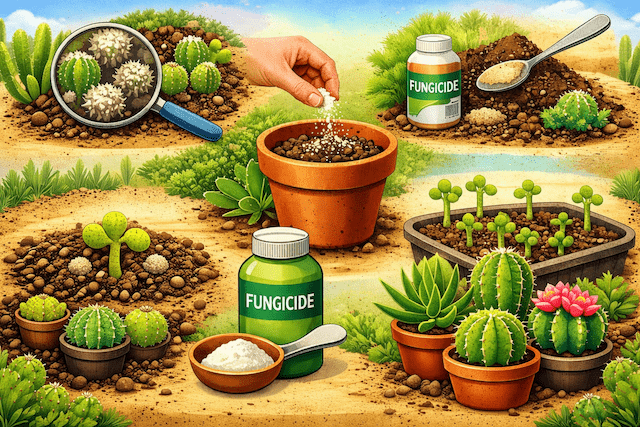
Sowing cacti and succulents is always a process with elevated risk. High humidity, warmth, fine substrates, and the weak immune systems of young seedlings create ideal conditions not only for germination, but also for fungal diseases.
For this reason, the use of fungicides at sowing is one of the most debated topics among collectors and professional growers.
As an agronomist with many years of hands-on experience, I will say this clearly from the start:
there is no universal “yes” or “no” answer.
Everything depends on conditions, goals, and cultivation philosophy.
Why are fungicides used at sowing at all?
The most common problems during early germination are:
seed rot before emergence;
damping-off (“black leg”) in seedlings;
surface mold on the substrate;
outbreaks of Fusarium, Pythium, Rhizoctonia;
mass loss of seedlings during the first 2–6 weeks.
Fungicides are used primarily as a preventive measure, not as a cure — once seedlings are affected, treatment is usually too late.
✅ Advantages of using fungicides
1. Reduced losses at the earliest stage
The most obvious benefit is lower mortality of seeds and seedlings, especially with:
rare and expensive seeds;
slow-germinating species;
collector forms (variegated, crested, genetically unstable lines).
2. More stable and predictable results
Fungicides allow growers to:
keep sowings closed for longer periods;
tolerate minor mistakes in moisture control;
achieve more uniform germination.
This is particularly important in commercial or semi-professional production.
3. Control in sterile substrates
When using sterile or mineral substrates (pumice, perlite, coconut fiber), fungicides:
4. Reduced stress for the grower
Not a scientific term — but very real 🙂
Fungicides reduce the number of situations where “everything was fine yesterday, and everything is gone today.”
❌ Disadvantages and risks
This is where the most important considerations begin.
1. Suppression of beneficial microflora
Fungicides do not distinguish between “good” and “bad” fungi.
They suppress:
As a result, seedlings may:
2. Reduced germination due to overdose
This point is critical and often underestimated.
Excess fungicide directly reduces seed germination.
When overdosed:
some seeds fail to germinate at all;
germination becomes delayed or uneven;
overall germination can be worse than in sowings where no fungicides were used at all.
This is especially noticeable in sensitive genera such as:
In this case, “more protection” clearly means a worse outcome.
3. “Sterile dependency”
Seedlings grown in completely sterile conditions may:
struggle to adapt after pricking out;
develop weaker root systems;
react more sharply to changes in environment.
4. False sense of security
Fungicides do not compensate for:
If cultivation practices are flawed, fungicides merely postpone the problem.
When is fungicide use justified?
✔ rare and valuable seeds
✔ large or mass sowings
✔ high humidity and closed-sowing methods
✔ unstable or cool climatic periods
✔ situations where substrate sterilization is not possible
When can fungicides be avoided?
✔ small hobby sowings
✔ good air circulation
✔ fully mineral substrates
✔ gradual ventilation from an early stage
✔ when the goal is resilient, naturally adapted plants